A Thousand Fish, More or Less: How Britain Measured Herring
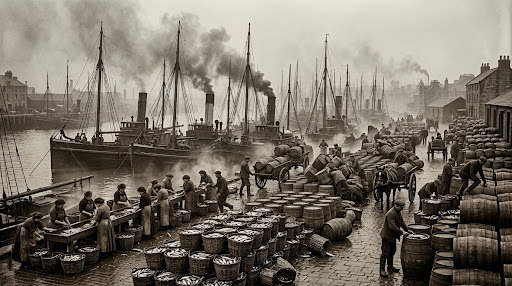
On a good night in the autumn of 1907, the drifters came into Great Yarmouth so heavily laden that boats queued offshore waiting for space at the wharf. Six thousand Scottish women were in the town to deal with what they brought. The best of them could gut a herring every second, and they sang while they did it.
Nobody counted the fish. There was no time, and no need. The whole trade ran on a measure that deliberately avoided counting anything at all.
The Cran: Thirty-Seven and a Half Gallons of Fish
A cran is a volume. Thirty-seven and a half imperial gallons of untrimmed herring, straight from the boat, gills and guts and all.
How many fish is that? Commonly about twelve hundred — but counts from seven hundred to two and a half thousand are on record, depending entirely on the size of the run. A cran of big autumn herring holds far fewer fish than a cran of small ones, and the price per cran was the same either way.
That sounds like a recipe for endless argument, and it was. But the alternative was worse. Counting a boat's catch fish by fish would have taken longer than catching it, and herring will not wait: a catch landed at dawn had to be gutted, salted and barrelled before it turned. Measuring by volume meant a crate could be filled, checked by eye and carried off the quay in seconds.
Which Cran, Though?
For centuries, the answer depended on where you were standing.
Every port had its own reckoning, and the differences were not small. A curer buying by the cran in one town and selling by the cran in another could make money on the discrepancy alone, which is precisely the sort of thing that eventually attracts legislation.
It came in 1908. The Cran Measures Act fixed the cran at thirty-seven and a half imperial gallons and made it, along with its quarter, the only lawful measure for selling fresh herring. Herring could still be sold by weight, by number, or in bulk. But sell by measure, and it had to be a cran or a quarter cran, in a crate stamped and inspected.
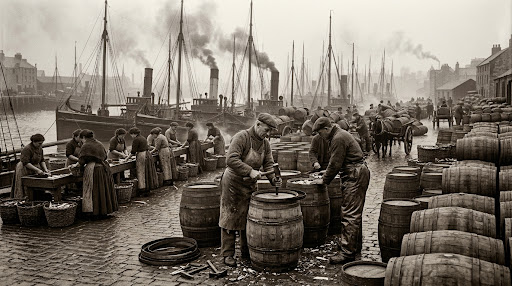
The quarter cran basket became the defining object of the herring ports. Stacked in thousands along the quays at Yarmouth and Lowestoft each October, it held nine and three-eighths gallons, and it was the unit in which the entire east coast counted its autumn.
The scale of it: In 1919 the Yarmouth fleet landed something over 450,000 crans in a single season. At a conservative thousand fish to the cran, that is getting on for half a billion herring, landed at one port, in roughly three months.
Counting the Fish Anyway
The cran solved the problem of the quayside. It did not solve the problem of the market, where fish were sometimes sold by number after all, and where the counting conventions were gloriously inconsistent.
A mease was five hundred herring. Or six hundred. Or, in one account of the Aberystwyth fishery, a nominal six hundred that actually contained six hundred and twenty, arrived at by setting aside one tally fish every two score and another every sixth score.
A last was around ten to twelve thousand fish, or about twelve packed barrels, and it was the unit in which the export trade to the Continent was reckoned.
A warp was four fish, because a tallyman could pick up two in each hand. Except in Wales, where a warp was a tally fish set aside for every two score, and therefore meant forty. Two trades, one word, an order of magnitude between them, and no evidence that either was aware of the other's usage.
The Hundred That Was Not a Hundred
Underneath all of this sits the long hundred, and it is worth pausing on because it explains most of the confusion above.
The fish trade counted in hundreds of 120, not 100. That much is straightforward. What is not straightforward is that the figure varied by port and by species, because it depended on how the tally was kept.
Fish were thrown into piles, with an extra tally fish set aside at intervals. Twelve lots of ten, with a tally fish each, gives 132. Six lots of twenty gives 126. Three lots of forty gives 123. In West Cornwall a hundred of pilchards was 120 but a hundred of herring was 132; elsewhere in Cornwall a hundred of pilchards was 126; in parts of Wales it ran to 123 or 124.
None of this was anyone being difficult. It is simply what happens when a counting method becomes a counting unit, and the method varies from quay to quay.

The Women Who Followed the Fish
The herring shoals migrated south down the North Sea through the year, and the workforce migrated with them. From the age of fifteen, women from the north and north-east of Scotland travelled the coast in crews of three: two gutters and a packer.
They worked at a wooden trough called a farlane, standing in oilskins with their fingers bound in strips of cloth against the salt and the knife. The gutting rate that is always quoted is one fish per second, and contemporary accounts suggest it is not an exaggeration. The packer layered them into barrels, tails inward, with salt between each tier, and called out for the cooper when a barrel was full.
At Yarmouth the call was "bottom tier", and older residents of the town still remember it.
They were not passive. The Scottish herring women struck in 1936 and won a pay increase, and struck again in 1938, that time in support of the drifter crews as much as themselves.
What Finished It
The First World War severed the German and Russian export markets, which had taken the bulk of the cured catch, and the trade never fully recovered. By the mid-1930s the British catch had fallen by more than half. The Scottish drifter fleet at Yarmouth dropped from over seven hundred boats in 1925 to around four hundred and sixty a decade later.
The cran outlasted the industry it served. The 1908 Act stayed on the statute book for most of the twentieth century, and quarter cran baskets turn up in museums and on harbour walls all along the east coast, a measure without a trade.
Why Measure Rather Than Count
There is a principle here worth extracting.
A cran does not tell you how many herring you have. It tells you how much herring you have, which for a curer filling barrels is the more useful number anyway. The imprecision that looks like a flaw is actually the point: it trades an exact figure nobody needed for a rapid one everybody could check.
Most customary measures work this way. They are not failed attempts at precision. They are precise about the thing that mattered and vague about the thing that did not, and working out which is which tells you a great deal about the trade that produced them.
Illustrations in this article are generated impressions, not contemporary photographs.