Three Barleycorns to an Inch: Fixing the Foot and the Yard
Here is the problem with measuring things against your body: everybody has one, and they are all different.
The foot and the yard are the two most intuitive units ever devised and the two hardest to make legal. A foot is obvious until you need yours to agree with mine. A yard is obvious until the man selling the cloth has longer arms than the man buying it. Both units took six centuries to pin down, and the story of how runs through a grain of barley, a king's nose, a brass bar, a fire that destroyed Parliament, and finally a surrender to the metric system.
Whose Foot?
Almost every civilisation that built anything used a foot, because a carpenter can step out the length of a room without putting down his tools.
The Greeks had the pous, which varied between city-states. The Romans had the pes, around 11.65 modern inches — noticeably shorter than ours, and sized to military pacing rather than carpentry. In medieval England a working foot might be anywhere from 10 to 14 inches, and which one applied generally depended on the local lord, or more precisely on the local lord's boots.
For a cottage this hardly matters. For a cathedral, a bridge, or a contract to supply timber by the foot, it matters enormously, and the people it matters to most are the ones being paid by it. A short ruler is a pay cut applied quietly.
1305: Anchoring a Unit to Barley
The English solution was clever and slightly odd: if a body cannot be trusted, use a plant.
The Compositio Ulnarum et Perticarum, around 1305, defined one inch as three grains of dry barley laid end to end. Twelve of those inches made the statute foot.
Barley is not a precision instrument, and any individual grain is a poor standard. But barley has two advantages over a nobleman's foot. It is available to everybody, which means any merchant can check a ruler without applying to anyone for permission. And nobody owns it, which means nobody can quietly adjust it in their own favour.
That is the real function of the barleycorn definition. It moves the standard out of the hands of the people with an interest in the outcome.
The Yard and the Royal Nose
The yard took a different route, and its origin story is better known than it deserves to be.
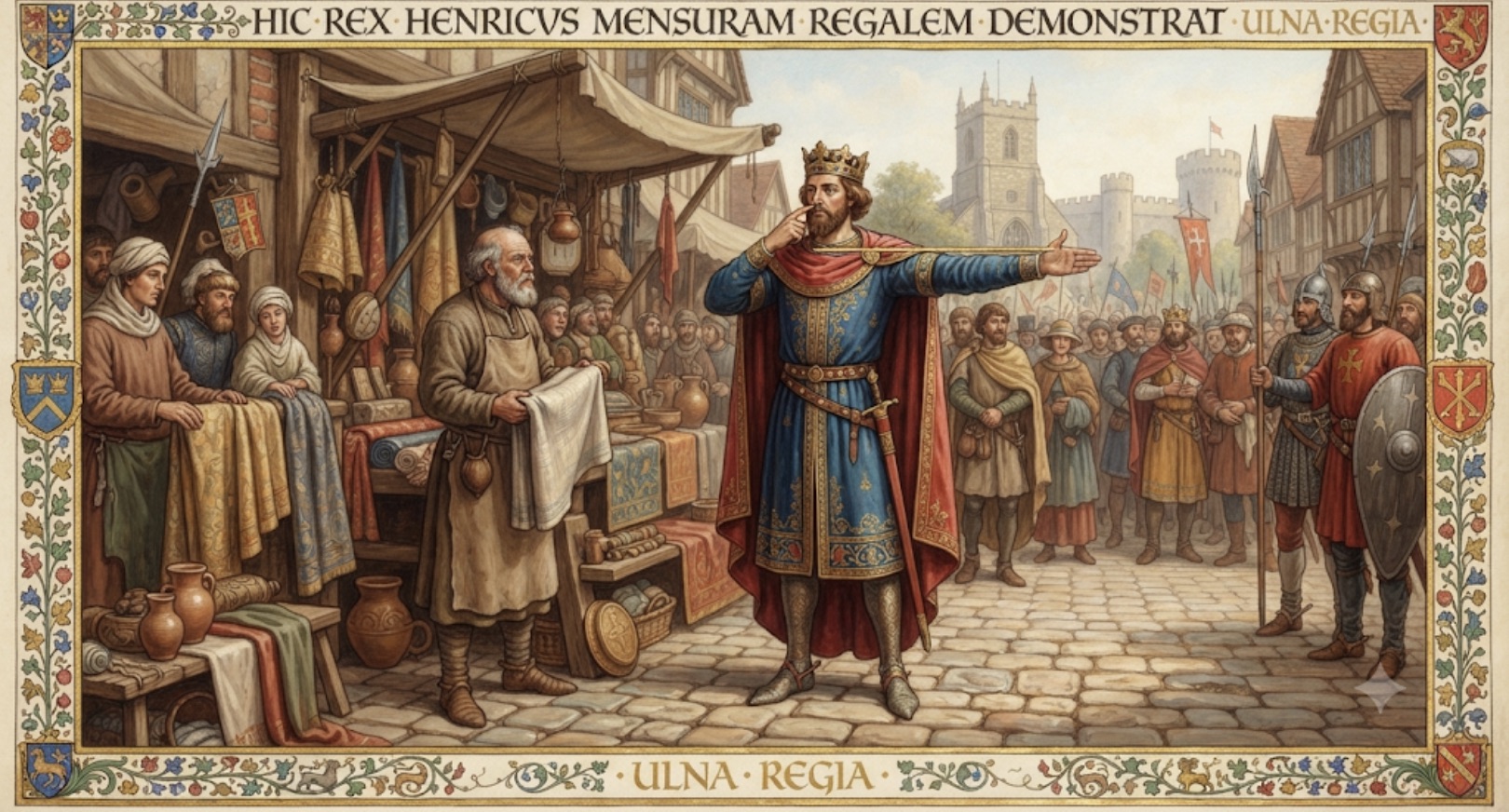
The word comes from the Old English gyrd, a twig or measuring rod. Cloth merchants needed something quicker than a rod and measured from the centre of the chin to the tip of the outstretched thumb, which is roughly a yard on a roughly average person and the source of endless argument otherwise.
Folklore has Henry I settling the matter by decreeing the yard to be the distance from his own nose to the thumb of his outstretched arm. It is a good story and it is almost certainly just a story — the kind of explanation that attaches itself to a unit after the fact. What is true is that the yard, like the foot, spent centuries being approximately right and legally unenforceable.
1824: The Bar in the Palace
The Imperial reform that fixed British volume fixed length too, and it did so by abandoning nature altogether.
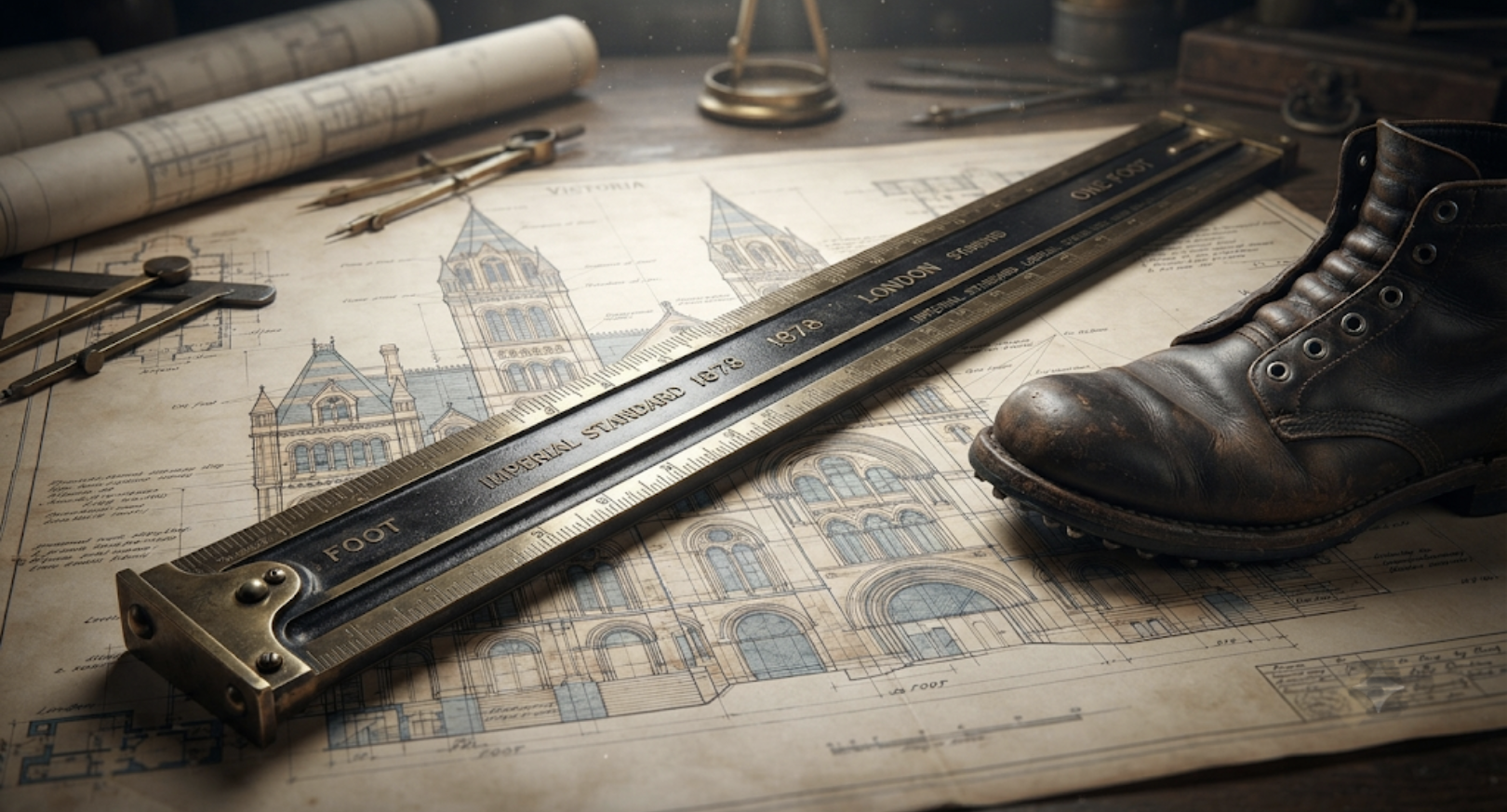
Parliament commissioned the Imperial Standard Yard: a solid brass bar with two gold pins set exactly 36 inches apart. Not a definition anyone could reproduce from barley. A specific object, in a specific building, that every ruler in the country was ultimately a copy of.
This is a genuine change in philosophy. The barleycorn definition said the standard lives in the world and anyone may consult it. The brass bar said the standard is this thing, here, and your ruler is correct insofar as it agrees with it.
It is more accurate. It is also considerably more fragile, and ten years later Britain found out exactly how fragile.
1834: The Fire
In October 1834 the Houses of Parliament burned down.
The fire started with the disposal of the exchequer's old tally sticks — notched wooden rods that had recorded government debts for centuries, rendered obsolete and fed into the furnaces beneath the House of Lords. The furnaces overheated. The building caught. By morning most of the medieval Palace of Westminster was gone.
So was the Imperial Standard Yard. The brass bar was damaged beyond use, and with it the physical definition of length in Britain and across its empire.
There is a grim symmetry to it. An obsolete measuring system, burned as rubbish, destroyed the object that defined the system replacing it.
Rebuilding From Copies
What followed is the most impressive part of the story and the part nobody tells.
With the original gone, the only surviving evidence of what a yard was consisted of copies made from it before the fire. Those copies disagreed, slightly, as copies do. Recreating the standard meant comparing them against each other, modelling how each had expanded and contracted with temperature since it was cut, and reasoning backwards to the bar that no longer existed.
It took years. The replacement was cast in a bronze alloy chosen for dimensional stability, known as Baily's metal after the astronomer whose work underpinned the comparisons.
The result was good. Good enough that when the English-speaking world finally agreed a common definition in the twentieth century, the Victorian reconstruction was the thing being defined.
1959: The Metre Wins
The last move is the one with the irony in it.
In 1959 the English-speaking nations agreed to define the yard as exactly 0.9144 metres, and the foot as exactly 0.3048 metres. Not approximately. Exactly — the figures were chosen to split the small differences between the British and American versions.
Which means that the foot, a unit named after the human body and defended for a century against French revolutionary mathematics, is now officially a fraction of a metre. The barleycorn is gone. The brass bar is a museum piece. What a foot is, legally, is 304.8 millimetres.
The unit survived. The thing that defined it did not.
What the Sequence Shows
Four definitions in six hundred years, and each one moves the standard further from the people using it.
A lord's foot is near at hand and completely unreliable. Barley is reliable enough and available to anyone. A brass bar in a palace is highly reliable and available to almost nobody. A fraction of a metre is perfectly reliable and entirely abstract.
That is the trade the modern world made, and it made it for good reasons — nobody building a bridge wants the span to depend on whose boots were handy. But something is lost at each step, and it is worth noticing what: the ability of an ordinary person to check, from first principles, whether they are being cheated.
Three barleycorns, end to end, is a standard a labourer could verify in a field. 304.8 millimetres is a standard you have to take on trust.