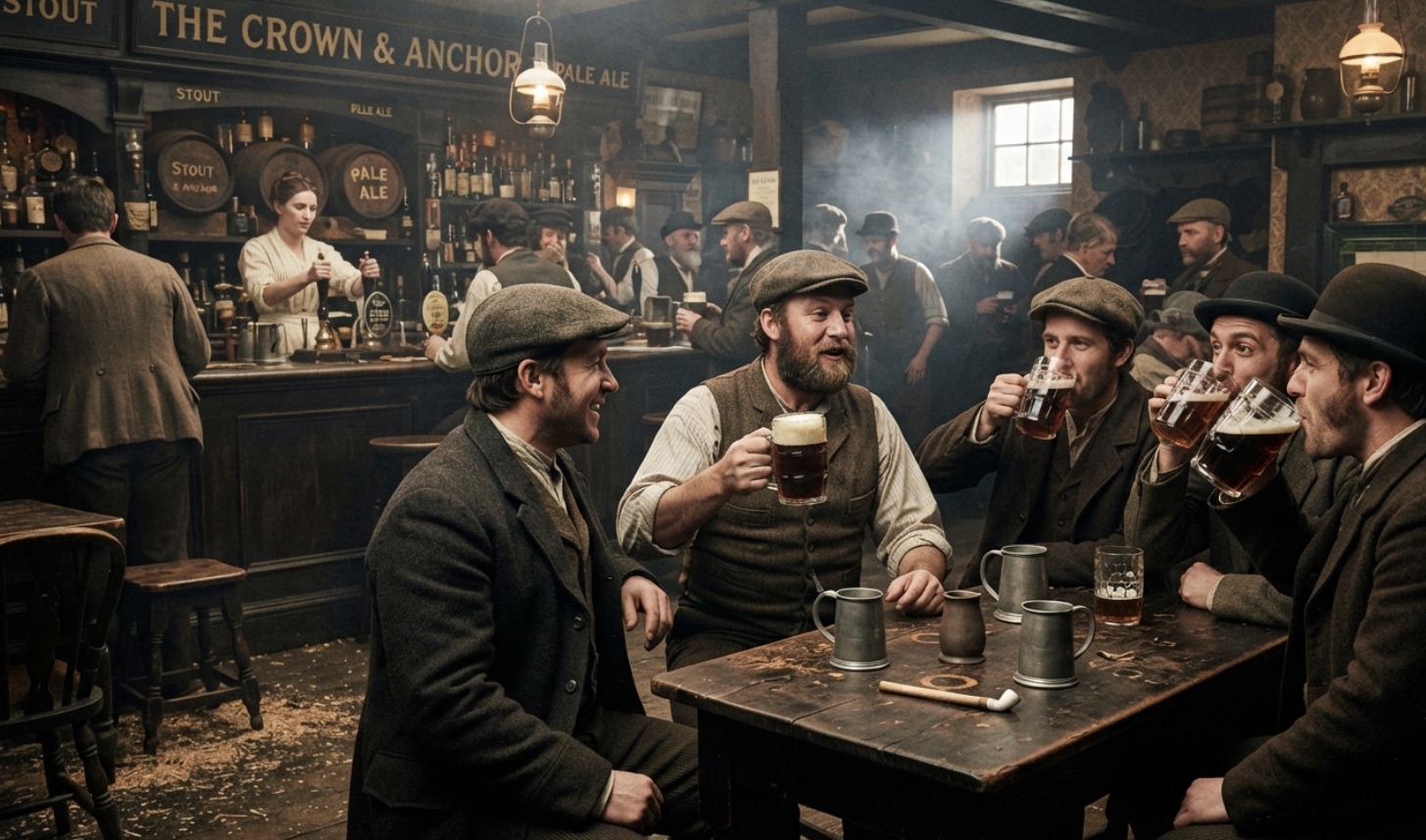
Four gills make a pint. Two pints make a quart. Four quarts make a gallon. Two gallons make a peck, and four pecks make a bushel.
Read that again and notice what is not there: no sevens, no elevens, no awkward remainders. Every step up British volume is a doubling or a quadrupling, which means the whole system can be climbed by halving and halving again — in your head, in a cellar, in bad light, with cold hands.
That is not decoration. It is the entire design.
The Ladder
| Unit | Equals | Fluid ounces |
|---|---|---|
| Fluid ounce | — | 1 |
| Gill | 5 fl oz | 5 |
| Pint | 4 gills | 20 |
| Quart | 2 pints | 40 |
| Gallon | 4 quarts | 160 |
| Peck | 2 gallons | 320 |
| Bushel | 4 pecks | 1,280 |
A system built for people who could not read a decimal point but could certainly divide something in half.
The Fluid Ounce: Where Weight Meets Volume
Start at the bottom, because the bottom is where the cleverness is.
The fluid ounce was designed to solve a problem that sounds abstract and was not: how do you move between the weight of a solid and the volume of a liquid without recalculating every time? An apothecary dissolving a powdered medicine into a tincture needed both numbers, and needed them to agree.
The answer was to define the fluid ounce as the volume occupied by one avoirdupois ounce of water. One fluid ounce of water weighs one ounce. The scales on the chemist's bench and the jug on the merchant's counter were describing the same thing in two languages, and the translation was free.
This is also where Britain and America part company. The Imperial pint holds 20 fluid ounces; the American holds 16. The British figure is not arbitrary — it is what falls out of anchoring the gallon to ten pounds of water. The American pint descends from the older wine gallon instead, and the two systems have been quietly incompatible ever since.
The Gill: Five Ounces and a Great Deal of Folklore
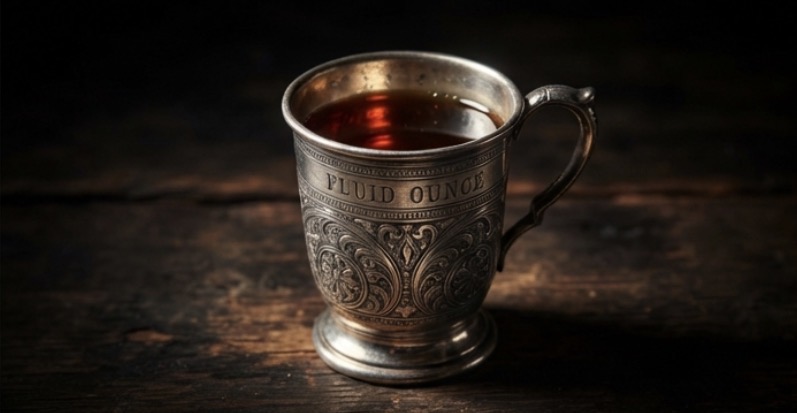
A gill — pronounced with a soft j, which catches out almost everyone — is a quarter of a pint. Five fluid ounces.
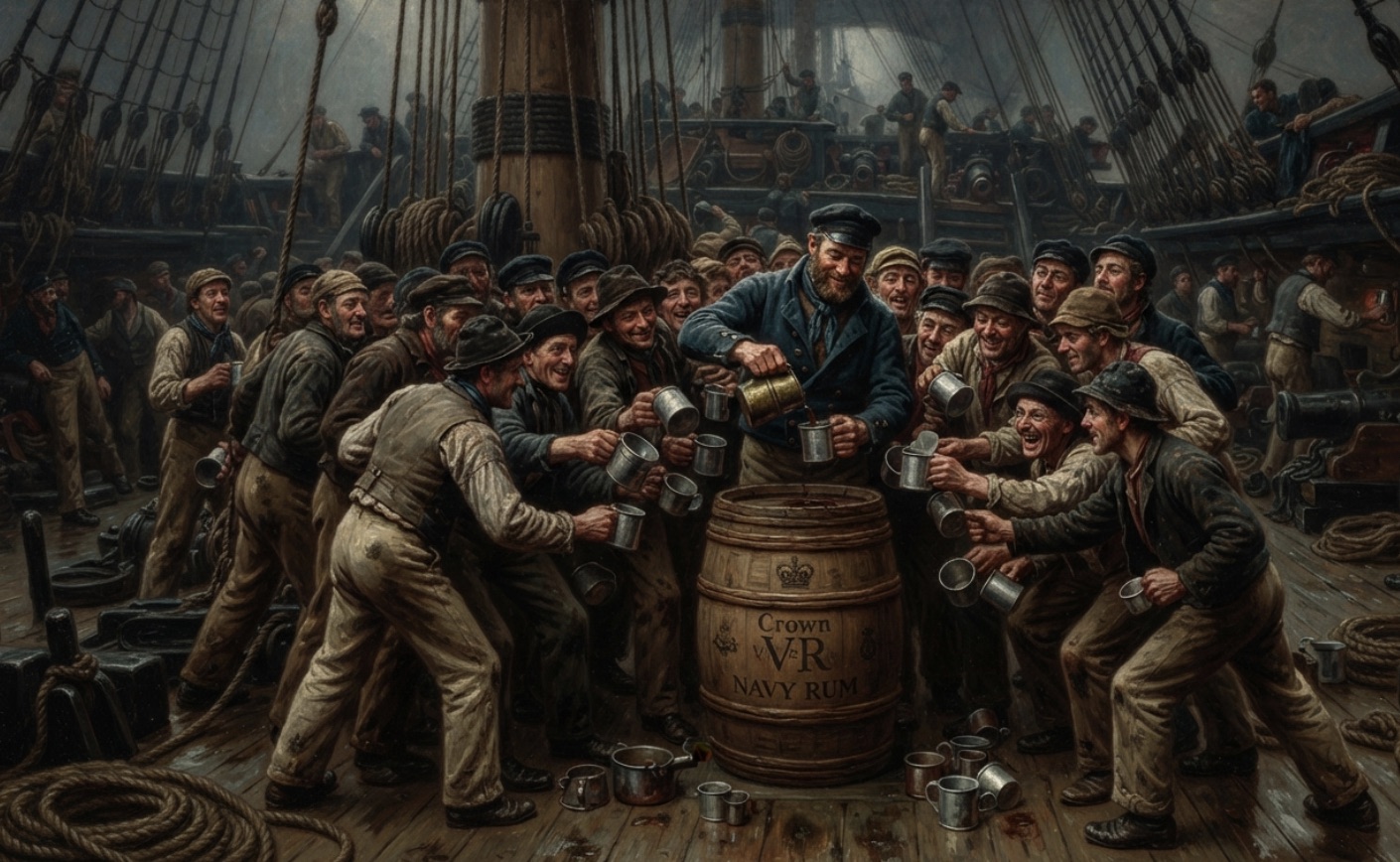
It came out of the medieval apothecary trade, where measuring a tincture accurately was a matter of life and death, and it ended up in the Royal Navy, where the daily rum ration was issued by the gill. That tradition ran until Black Tot Day, 31 July 1970, when the last rations were poured.
There is a popular story that Jack and Jill of the nursery rhyme are the jack — a half-gill — and the gill itself, devalued by Charles I to raise revenue on liquid measures, so that when the jack fell the gill came tumbling after. It is a lovely explanation and almost certainly invented. The rhyme is not recorded until the late eighteenth century, well over a hundred years after Charles I, and no contemporary source connects the two. Like a great many measurement stories, it survives because it deserves to be true rather than because it is.
What is true is stranger. When spirits began to be sold in fractions of a gill, England settled on a sixth and Scotland on a fifth — so a single measure north of the border was meaningfully larger than the same order in London. Metric measures of 25ml and 35ml replaced the gill fractions, but the regional divide survived the changeover intact. A single is still larger in some parts of Britain than others, for reasons that date to a unit nobody has used by name in fifty years.
The Pint: The One That Survived
Four gills. Twenty fluid ounces. The only unit on this ladder that an ordinary person still uses by name, and the one Britain has been least willing to give up.
For centuries it was a moving target. A pint of wine, a pint of ale and a pint of corn were three different volumes, because each descended from a different gallon — and we will come to the gallons shortly. The gap was wide enough to be worth exploiting, and it was exploited: thick-bottomed pewter mugs and shallow leather jacks were standard equipment for an innkeeper of flexible morals.
The name may come from the Old French pinte, possibly in turn from a Latin word meaning painted, after the fill line marked on the side of a tavern mug. That derivation is widely repeated, though the origin of the French word is generally given as uncertain, so take it as a likely story rather than a settled one.
What settled the pint itself was the Act of 1824, and the stamp that came with it: inspectors travelled the country marking honest vessels with a royal crown. The pint stopped being a matter of opinion.
The Quart: The Household Unit
Two pints, and the volume at which British domestic life was actually conducted.
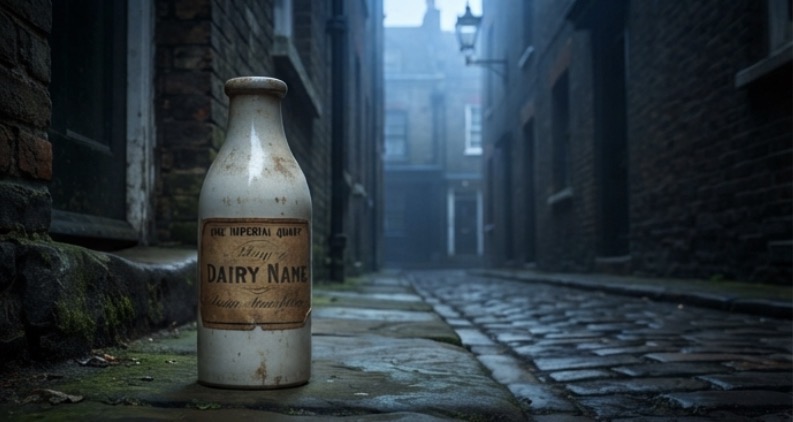
Before refrigeration, a household could not store perishables in bulk. A quart was roughly what a family got through in a day — of milk, of ale, of cooking oil — which is why it became the standard delivery size and the standard jug size. Children were sent to the public house with an empty stoneware jug to fetch a quart of bitter for the family dinner, and the phrase "fetching the beer" survived the practice by a generation or two.
The quart also demonstrates how badly the system worked before 1824. The Scots quart held nearly three times the volume of the English one. Not a rounding difference, not a matter of a generous landlord — three times. For anyone trading across the border, that was not an inconvenience; it was an invitation.
The Gallon: Three of Them, Then One
Here is the hinge of the whole story, and the reason everything below it was chaotic for so long.
Before the nineteenth century, England ran three competing gallons at once:
- The wine gallon — 231 cubic inches, fixed by statute under Queen Anne in 1707, for imported wine and spirits.
- The ale gallon — 282 cubic inches, a Tudor standard, for domestic malt liquor.
- The corn gallon — 268.8 cubic inches, for dry grain, descended from the Winchester standards held since the Saxon period.
Three gallons meant three pints, three quarts, three of everything beneath them. Which one applied depended on what was in the barrel, and excise collectors and merchants spent the better part of two centuries arguing the point. The difference between the wine gallon and the ale gallon is over twenty per cent, which is a great deal of money on a shipload.
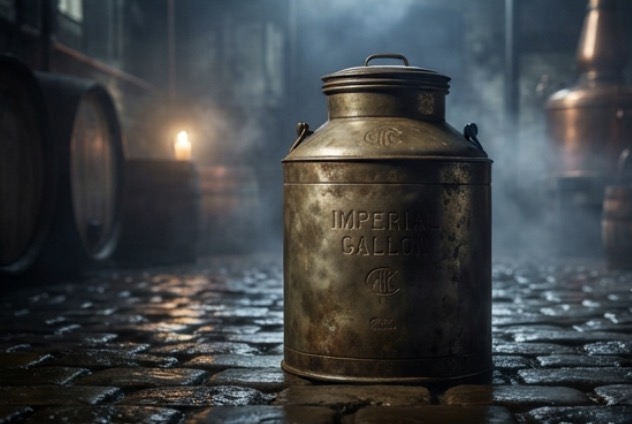
The 1824 Imperial reform swept all three away and replaced them with a definition of real elegance: the Imperial Gallon is the volume of ten pounds of distilled water at 62 degrees Fahrenheit.
Look at what that does. It anchors volume to weight, and weight to a substance anyone can obtain. It makes the fluid ounce of water weigh exactly one ounce, because 160 fluid ounces of water weigh 160 ounces, which is ten pounds. The whole ladder above and below falls into place from one sentence about water.
That is why 1824 appears in every section of this piece. It is the year British volume stopped being a collection of local customs and became a system.
The Peck: A Basket Before It Was a Number
Two gallons, or a quarter of a bushel. And for most of its life, not a number at all.
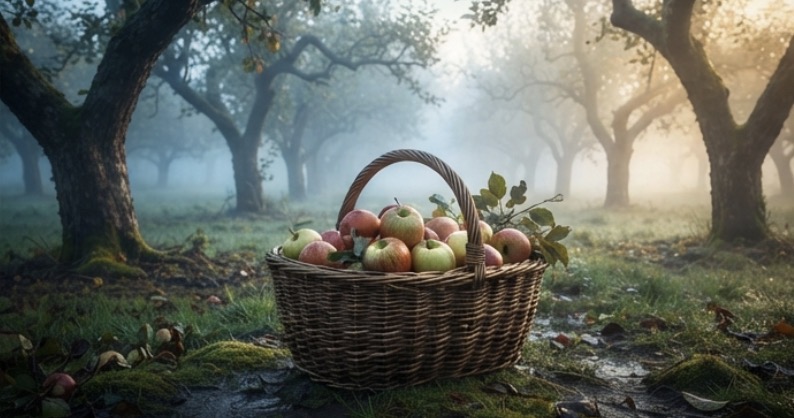
The peck was a physical object first: a hand-woven wicker basket of the size a labourer could carry under one arm or strap at the waist while working down a row of apple trees or hop poles. It was standardised by what a person could comfortably lift, which meant it varied by county, by crop and by whoever wove the basket. A peck of peas in Kent and a peck of oats in Yorkshire were not the same quantity, and since tithes and manorial dues were often paid in pecks, this mattered.
Peter Piper has kept the word alive long after the thing itself became unfamiliar. The tongue twister dates from the early nineteenth century, which places it almost exactly at the moment the peck stopped being a basket and became two gallons.
It has not quite gone. Farm shops and pick-your-own orchards still sell apples by the peck, in baskets, which is the unit doing precisely what it always did.
The Bushel: The Top of the Ladder
Four pecks. Eight gallons. The unit on which the grain trade — and therefore a good deal of the medieval economy — was conducted.
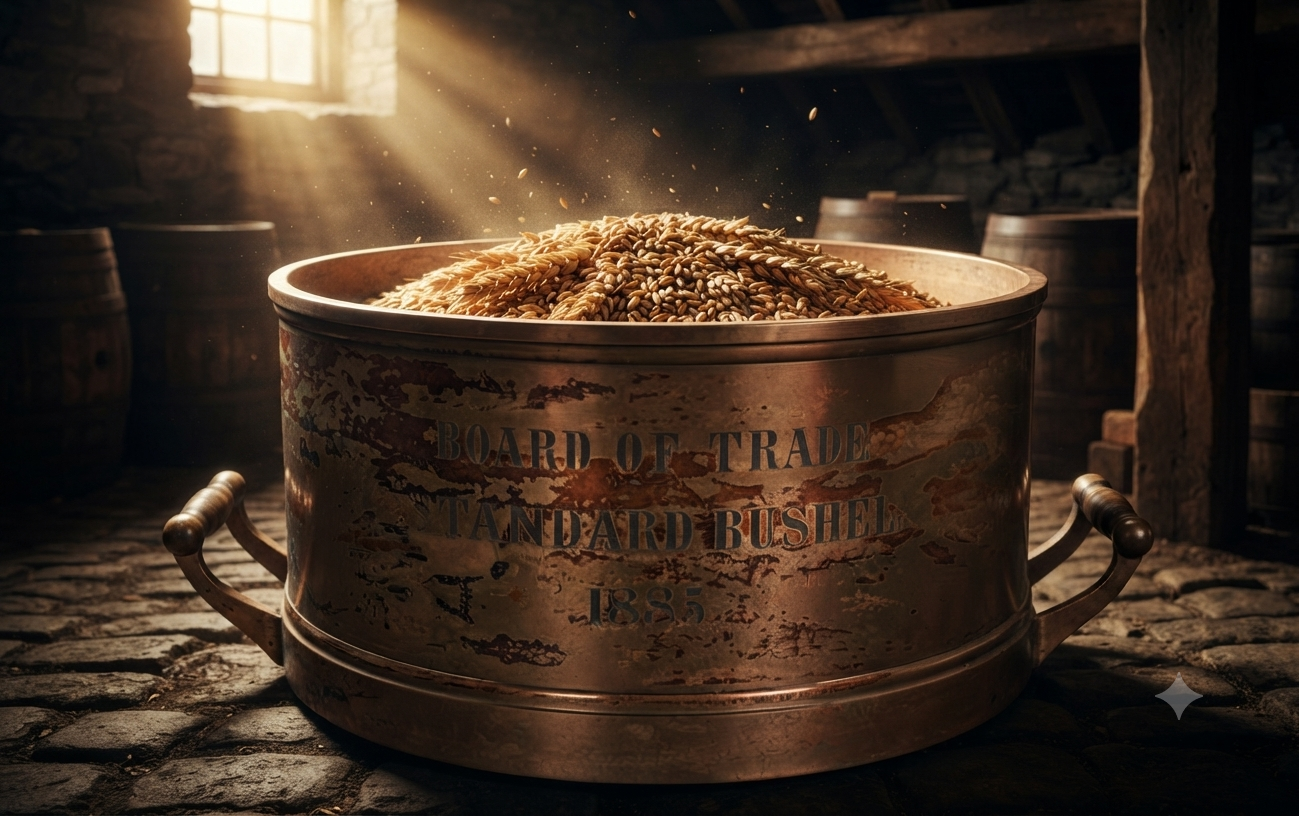
The Winchester bushel was the standard, a brass vessel kept in the royal treasury, and the rules for using it were strict. Grain had to be struck: filled to the brim and levelled off with a straight stick drawn across the top. Without that requirement, how firmly the grain was packed became a negotiating position, and the difference between loose and settled grain in a vessel that size is not small.
The 1824 Act redefined the bushel as eight Imperial gallons, slightly larger than the old Winchester measure, and that is the figure that stands today.
It is also the unit on this ladder with the largest afterlife. Global commodity exchanges still price wheat, corn and soybeans by the bushel. A measure defined by how much grain a brass pot in Winchester would hold, levelled with a stick, is still setting the price of harvests on the other side of the world.
Why Doubling
Return to the ladder and the design becomes obvious.
A merchant with a gallon measure can produce a half-gallon by filling it halfway up a marked line, a quart by halving again, a pint by halving again, and a gill by halving twice more. No arithmetic, no conversion table, no literacy required. Every unit is reachable from every other by an operation a person can perform physically, with a vessel, by eye.
Decimal systems are better for calculation and worse for this. Dividing by ten is easy on paper and awkward in a cellar; dividing by two is the opposite. The imperial volume ladder was built by people whose arithmetic happened in their hands rather than on a page, and it is shaped accordingly.
Which is why the pint survived metrication and the hectolitre never caught on in a pub. It is not sentiment, or not only sentiment. It is that twenty fluid ounces divides into halves and quarters that correspond to real vessels, and 568 millilitres does not divide into anything a person wants to hold.